








A short-term training course for hospitality and service industry specialists was organized in Rishton
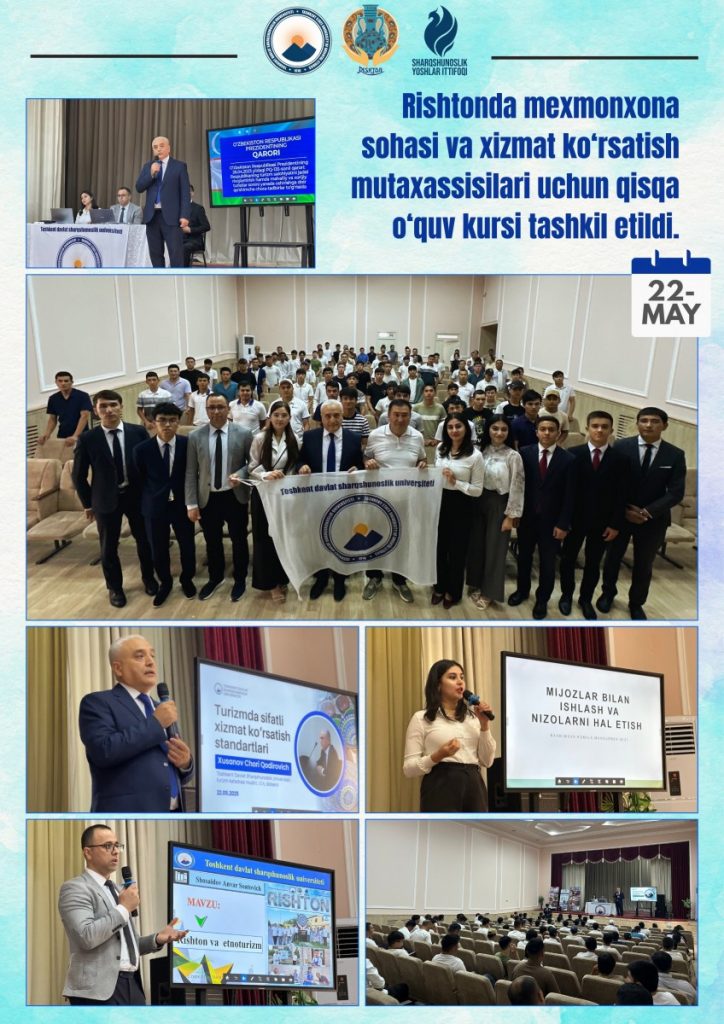
The Tourism Department of Tashkent State University of Oriental Studies, headed by Ch. Khusanov, organized a short-term training course titled “Service Standards and Customer Relations” for employees of the hospitality and service sectors in the Rishton district. The main goal of this course was to train qualified specialists who are client-oriented and meet the demands of modern service standards.
During the course, participants were provided with in-depth knowledge on service culture, client approach based on international standards, ethics, and communication methods in service. The lessons were divided into theoretical and practical parts, and key industry issues were thoroughly discussed.
Special attention during the course was given to developing skills for identifying problems that may arise in the service process, understanding customer needs correctly, and responding professionally to them. Effective strategies for managing stress in contentious situations with customers were also taught.
Around 200 representatives from the hospitality and service sectors of Rishton district participated in the course. This allowed them to enhance their professional knowledge and skills, as well as improve the quality of service.
Additionally, within the course framework, a seminar-training on “Working with Clients and Conflict Resolution” was held by K. Rakhimova, a graduate student of the Tourism Department and an experienced tour guide and translator. During the seminar, participants gained practical skills in effective communication with clients, managing difficult situations professionally, and positively resolving conflicts. The training was conducted interactively, where problems were analyzed based on real-life situations, and participants shared their views and experiences.
For industry representatives, a seminar-training on “Ethnotourism in Rishton” was conducted by A. Shosaidov, a teacher of the history of Central Asian countries. The seminar provided detailed information about the rich cultural heritage of the Rishton area, traditional crafts, national values, and their tourism potential. Participants offered interesting suggestions on developing ethnotourism in Rishton, expanding local community participation, and creating cultural programs for guests.
This training course became an important step toward enhancing the service culture in the tourism sector, training professional staff, and developing regional tourism. In the future, a number of other qualification improvement programs and training courses are planned to be organized as part of similar initiatives.
Social networks:
