








Address by the rector of Tashkent State University of Oriental Studies, doctor of philology, professor S. Nasirova
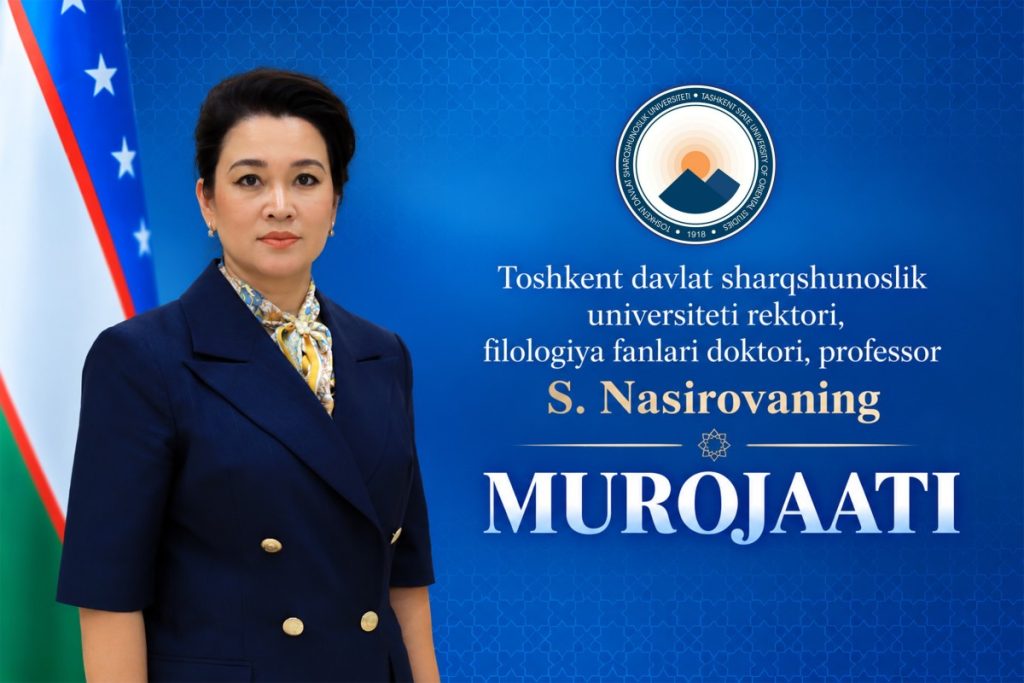
Dear students, master’s students, doctoral students, professors, lecturers, and members of the TSUOS community!
We fully support the reforms initiated by the President of the Republic of Uzbekistan, Sh. M. Mirziyoyev, aimed at bringing education and science to a new level, ensuring continuity among all their components, and establishing a unified system.
Today, our university community faces major and highly responsible tasks. Our mission is not only to provide academic knowledge, but also to train well-rounded professionals who are prepared to actively participate in the life of society. Graduates of our university are successfully demonstrating their potential in diplomacy, international relations, translation studies, history, pedagogy, ethnology, economics, politics, tourism, and other important fields.
In order to adapt to the demands of the times and the strategic objectives set by the Head of our State, we need to identify the following priority areas for the transformation of TSUOS:
- Continuity of Education and a Unified System. The University will establish close cooperation with specialized schools and academic lyceums, expand opportunities for supplementary education to provide young people with early career guidance and enable them to study Oriental languages in greater depth. To gradually engage talented young people, starting from school, in university education and research activities, a “green corridor” system will be introduced.
- Academic Autonomy and Modern Governance. Within the framework of expanding the academic autonomy of TSUOS, the University will introduce a KPI system for departments and academic staff and link incentive mechanisms to the outcomes of their research and teaching activities. A flexible “Roadmap” for the University’s development will be developed, administrative processes will be optimized, and a transition to project management in the administration of educational programs will be implemented.
- Digital Technologies and Artificial Intelligence. Interactive platforms powered by artificial intelligence technologies will be developed to facilitate the accelerated acquisition of Oriental languages. In addition, capabilities for automated text analysis, corpus data processing, and intelligent analysis of the media space will be expanded.
- Integration of Science, Education, and Practice. The University will continue implementing interdisciplinary and international research projects. In pursuit of the goal of entering the TOP 1000 universities, it is essential to increase the number of scholarly publications in journals indexed in the Scopus and Web of Science databases, as well as to establish mechanisms for putting scientific developments created by Oriental studies scholars into practical application.
- International Cooperation and Labour Market Orientation. TSUOS will expand joint educational programs and academic mobility opportunities with leading partner universities in Asia and Europe. Curricula will be updated in line with modern requirements in cooperation with key employers, including the Ministry of Foreign Affairs, analytical centers, tourism companies, and major businesses. This will contribute to ensuring the high competitiveness of our graduates in the labor market.
Addressing these wide-ranging and ambitious tasks requires the united, sincere, and concerted efforts of every member of TSUOS of all those who value the honor, reputation, and future of our university.
The University leadership is confident that by bringing together our experience, dedication, and academic and pedagogical potential, we will successfully accomplish all the tasks before us and ensure that Uzbek Oriental studies receives the recognition it deserves on the global stage!
Social networks:
